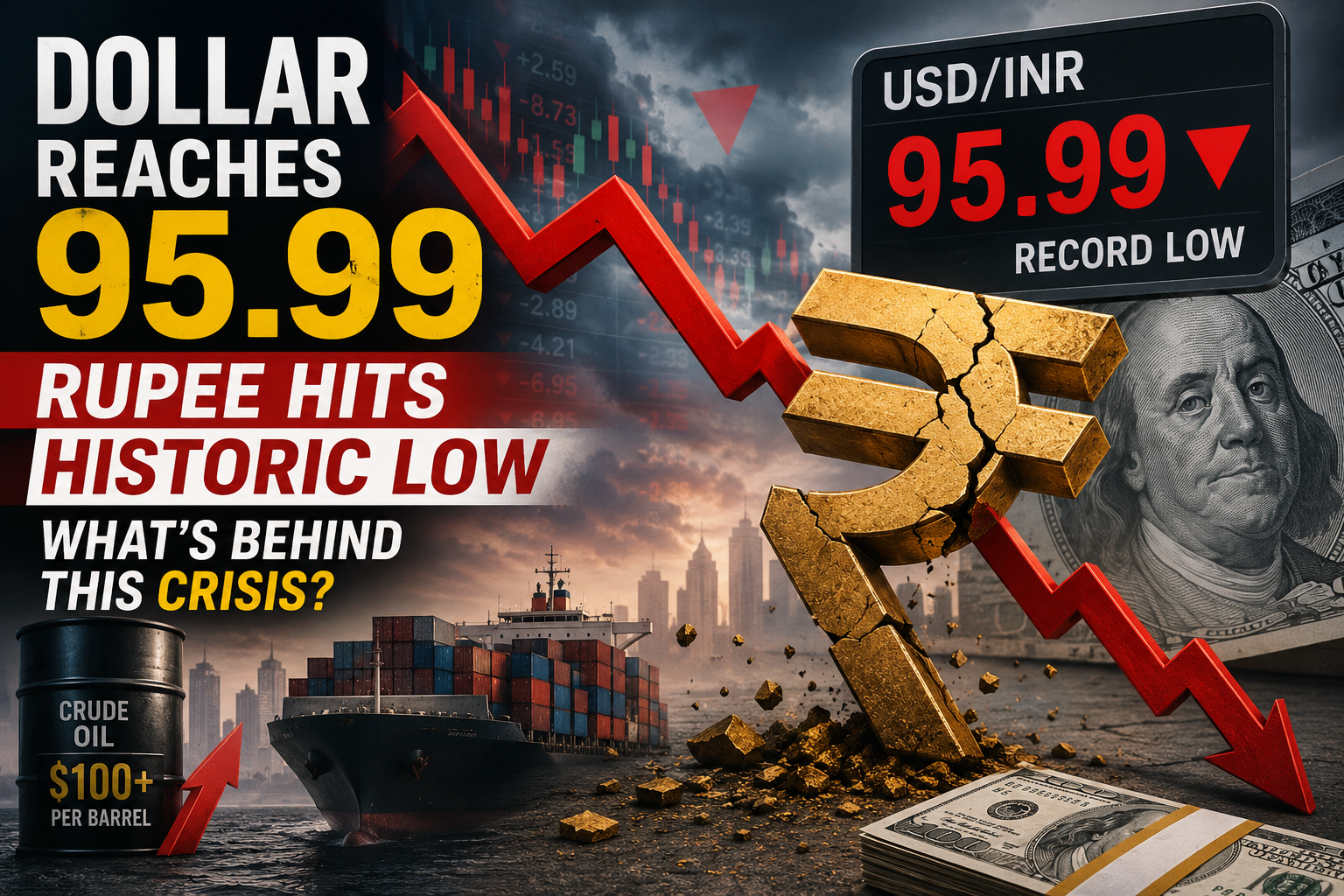
New Delhi/Mumbai, May 16, 2026 — The Indian rupee continues to weaken sharply against the US dollar. Recently, the USD/INR exchange rate touched around 95.99, marking a new record low. In some trading sessions, it even climbed to 96.14 before recovering slightly and closing near 95.86. This is the rupee’s biggest fall in 2026, making it one of the worst-performing currencies in Asia.
Why Is This Crisis Happening?
There are several reasons behind the rupee’s decline:
Skyrocketing Crude Oil Prices
India imports nearly 88% of its oil requirements. Rising tensions involving Iran, Israel, and the United States have pushed Brent crude prices above $100 per barrel. This could increase India’s import bill, widen the current account deficit (CAD), and create inflationary pressure.
Foreign Investors Pulling Out
Since the beginning of the year, nearly $20 billion in FII outflows have been recorded. Global uncertainty, strong US interest rates, and rising demand for the dollar as a safe-haven asset have increased pressure on the rupee.
Geopolitical Tensions
Fears of conflict in West Asia have strengthened the US dollar, while emerging market currencies continue to remain under pressure.
RBI Intervention
The Reserve Bank of India has attempted to stabilize the market using its $697 billion foreign exchange reserves. However, the pressure remains strong, and the rupee continues hitting fresh lows repeatedly.
What Will Be the Economic Impact?
Inflation Shock
Petrol, diesel, food items, medicines, and daily-use products could become more expensive.
Costlier Imports
Electronics, machinery, gold, and silver imports are likely to become more expensive.
Pressure on Corporates
Companies with foreign debt obligations may face higher repayment costs due to the weaker rupee.
Export-oriented sectors such as IT, pharmaceuticals, and gems & jewellery may benefit because dollar earnings convert into higher rupee income. NRIs may also gain, as money sent home becomes more valuable in rupee terms.
Political Controversy
Opposition parties are criticizing the government over the rupee’s decline. A 2013 clip of Finance Minister Nirmala Sitharaman has gone viral, where she described ₹62 per dollar as a “crisis,” while critics claim the current ₹95–96 levels are being downplayed. The government argues that compared to other emerging market currencies, the rupee has performed relatively better.
What Lies Ahead?
Analysts believe that if oil prices remain elevated and FII outflows continue, the dollar could rise toward 98–100 by the end of the year. However, strict monitoring by the RBI and support from domestic buyers may help prevent further sharp depreciation.
Conclusion
The dollar crossing 95.99 is not just a number — it reflects India’s import dependence, global uncertainties, and the challenges of currency management. Ordinary citizens may face rising inflation, while the government and RBI will need balanced policies to stabilize the economy.
Is this a full-blown crisis or just temporary pressure? Time will tell. But for now, the weakening rupee has become a growing concern for every Indian.
(This article is based on available news reports. Actual exchange rates may vary according to market conditions.)